Showing posts with label macOS. Show all posts

Friday, February 16, 2024

Apple's magic sound-file renaming

No comments:
This is based on a discussion thread I just started on TidBits Talk.

For those who are unaware, in macOS 11 (aka "Big Sur"), Apple changed all of the standard system sounds. If you compare the system sounds preferences of it (or newer) releases with prior releases, you'll see that the standard set changed:

Old (pre- Big Sur) macOS system sounds New (Big Sur and later) macOS system sounds
Basso Mezzo
Blow Breeze
Bottle Pebble
Frog Jump
Funk Funky
Glass Crystal
Hero Heroine
Morse Pong
Ping Sonar
Pop Bubble
Purr Pluck
Sosumi Sonumi
Submarine Sumberge
Tink Boop

Monday, August 22, 2022

How macOS tracks file metadata on non-Mac storage

No comments:
This article is based on a discussion thread on TidBITS Talk: Finding Type/Creator Tags in Old Mac Document Files.

In this thread, one reader asked how Macintosh file metadata (e.g. a file's type and creator codes) are preserved when a file is copied to non-Macintosh storage (e.g. a Windows file server or a FAT formatted hard drive). He observed that he can copy a file to a Windows server, then copy/move the file to several different locations from Windows, and then copy the file back to a Mac and the metadata is preserved.

Here is the result of my analysis.

Tuesday, May 25, 2021

Sophos: Apple patches dangerous security holes, one in active use – update now!

No comments:
Apple patches dangerous security holes, one in active use – update now!
By Paul Ducklin,

... security patches that arrived in the update to iOS 14.6, because Apple fixed 38 significant bugs, covered by 43 different CVE bug numbers.

For what it’s worth, the update to macOS Big Sur 11.4 shared many of those bugs with iOS, as well as adding a raft of its own, with 58 significant bugs patched, covered by 73 different CVE bug numbers.

Perhaps even more importantly, one of the Big Sur bugs that was patched, now dubbed CVE-2021-30713, is a security flaw that is already known to criminals and has already and quietly been exploited in the wild.

Time to update your phone again...

Friday, March 12, 2021

Thank you, Internet Archive

No comments:
When I upgraded my Mac last October, Apple's Migration Assistant utility migrated most of my applications to the new computer. As I wrote in December, the various applications all migrated with differing degrees of success.dfsdfgsdfg

One application where I spoke too soon was Snapz Pro X. Despite MacWorld's lackluster review of version 2.5.1, it is still a very good screen capture utility that I consider superior in many ways to the one built-in to macOS.

When I wrote my review in December, I didn't really test Snapz Pro X. I launched it, saw that the menu appeared, then I quit it and assumed that it worked. I was wrong.

Wednesday, March 03, 2021

Tip: Remote login to recover from missing display

No comments:

This morning, I found that my Mac’s screen wouldn’t wake up. The computer runs 24x7, with the screen blanking after a few hours of idle time. Nearly all of the time, I just tap a key on the keyboard to wake the screen when I want to use it.

This morning, that didn’t work. The screen remained asleep. I tried obvious things like hot-plugging the display and hot-plugging the keyboard, but no luck.

Tuesday, June 14, 2016

Ars Technica: Digging into the dev documentation for APFS, Apple’s new file system

No comments:
Digging into the dev documentation for APFS, Apple’s new file system
Copy-on-write metadata, native encryption, instant cloning, snapshots, and more.
by Lee Hutchinson - Jun 13, 2016 4:35pm EDT

Though the feature wasn’t mentioned in Apple’s WWDC 2016 keynote, I’m most excited about the introduction of the Apple File System, or APFS. The preliminary version of the developer documentation is online now, and it looks like the new file system introduces a whole boat-load of solid features—including a few out of the ZFS playbook.

APFS looks to be a major update over Apple’s old and creaky HFS+ file system, which has been around in one form or another for decades. It has been the subject of expansions and additions over the years, but HFS+ never approached the extensibility and flexibility of current next-generation file systems. Rather than continuing to bolt stuff onto the old code, we now (finally!) get a new file system that has some truly compelling features.

It'll probably be a while before this becomes mainstream, but what I've read so far looks really attractive. Especially support for snapshots, which is something I've been wanting ever since I discovered them as a part of Network Appliance's file server software almost 20 years ago. I assume Apple took so long to develop the tech because they were waiting for NetApp's patents to expire, or some other non-technical reason.

Once this ships (and has gone through the usual rounds of bug-fixing to fix the inevitable problems in something this big), it will be a truly compelling reason to upgrade to the latest version of Mac OS X ('scuze me, macOS.) Which is great, considering that the last few OS updates seem to be mostly cosmetic and app changes - things that really shouldn't need a whole-OS update.

Wednesday, October 29, 2014

OS X 10.10 Yosemite: The Ars Technica Review

No comments:
OS X 10.10 Yosemite: The Ars Technica Review

When the book is finally closed on the product line known as OS X, last year’s release of OS X 10.9 Mavericks may end up getting short shrift. Sure, it brought tangible energy saving benefits to Mac laptop owners, but such gains are quickly taken for granted; internal changes and new frameworks are not as memorable to customers as they may be to developers and technophiles. And while Mavericks included many new user-visible features, and even new bundled applications, the cumulative effect was that of a pleasant upgrade, not a blockbuster.

But for all its timidity and awkwardness, Mavericks marked a turning point for OS X—and in more than just naming scheme. It was the first OS X release from the newly unified, post-Forstall Apple. If iOS 7 was the explosive release of Jony Ive’s pent-up software design ethos, then Mavericks was the embodiment of Craig Federighi’s patient engineering discipline. Or maybe Mavericks was just a victim of time constraints and priorities. Either way, in last year’s OS X release, Apple tore down the old. This year, finally, Apple is ready with the new.

Ars Technica has an incredibly detailed (and long - 25 screens) article all about the latest version of Mac OS X. There's lots of interesting information in here for everybody, from system programmers to power users, to Mac afficionados, to people who just like to admire and criticize industrial design.

Wednesday, January 15, 2014

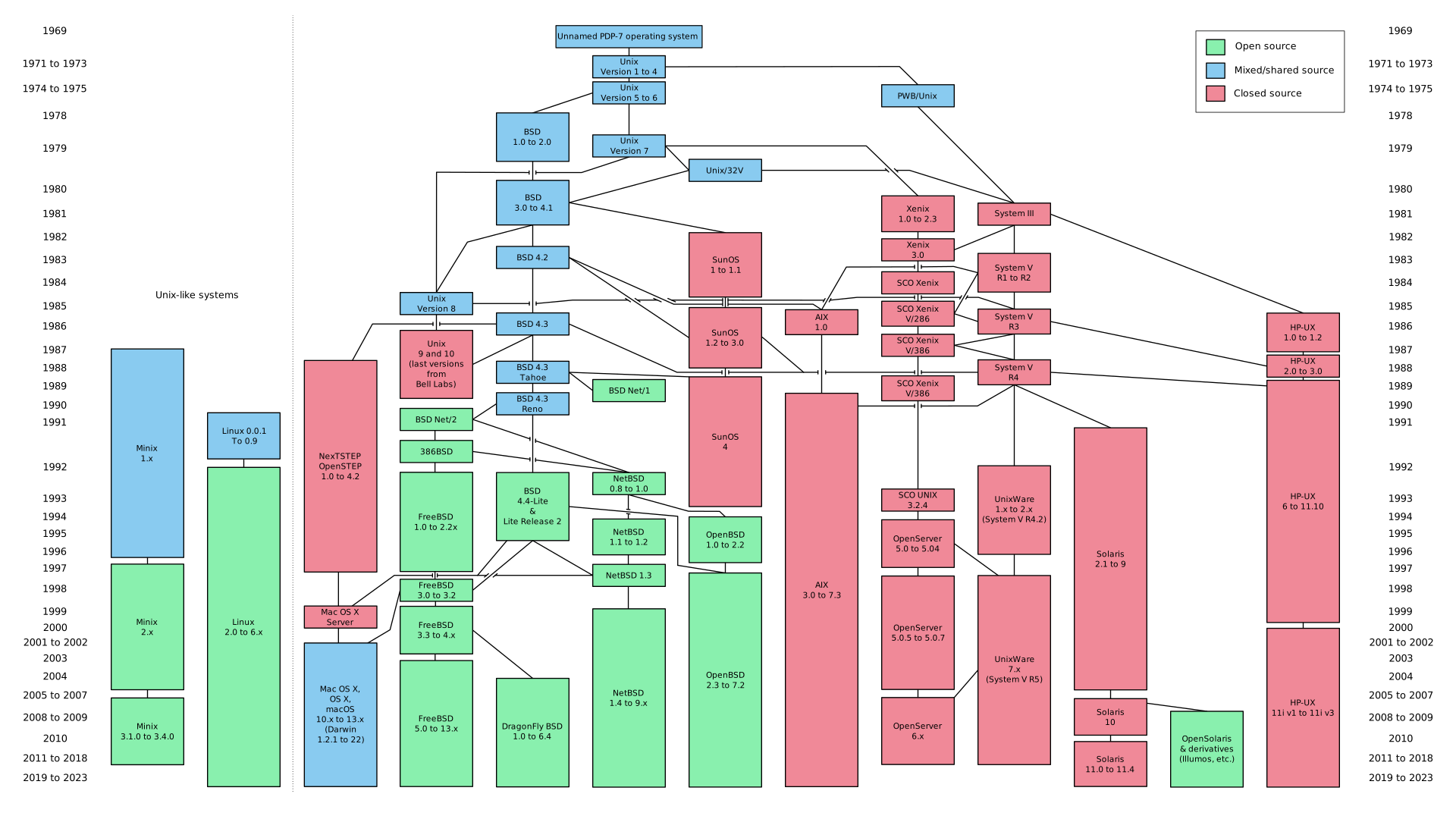
UNIX as religion?

No comments:
Or, as the article's author calls it, Over-Extended Metaphor for the day.

It's an amusing (if somewhat tenuous) way of drawing an analogy between the world/politics of UNIX-like operating systems and Christianity.

...
In the early days, the UNIX faith spread underground among nests of true believers; but they evangelized their friends and neighbours and gradually it began to spread in strange communities. And with the spread came the great split. By the mid-1970s there were two main sects: AT&T UNIX, which we may liken unto the Roman Catholic Church, and BSD UNIX, which we may approximate to the Orthodox Churches. And then lo, there were many schisms.
...
Read on...